

Definitions · AI & GPU compute
What is AI training?
What is AI training? Fitting a model to data on accelerators: what a run needs, how it differs from inference, and where the capacity comes from.
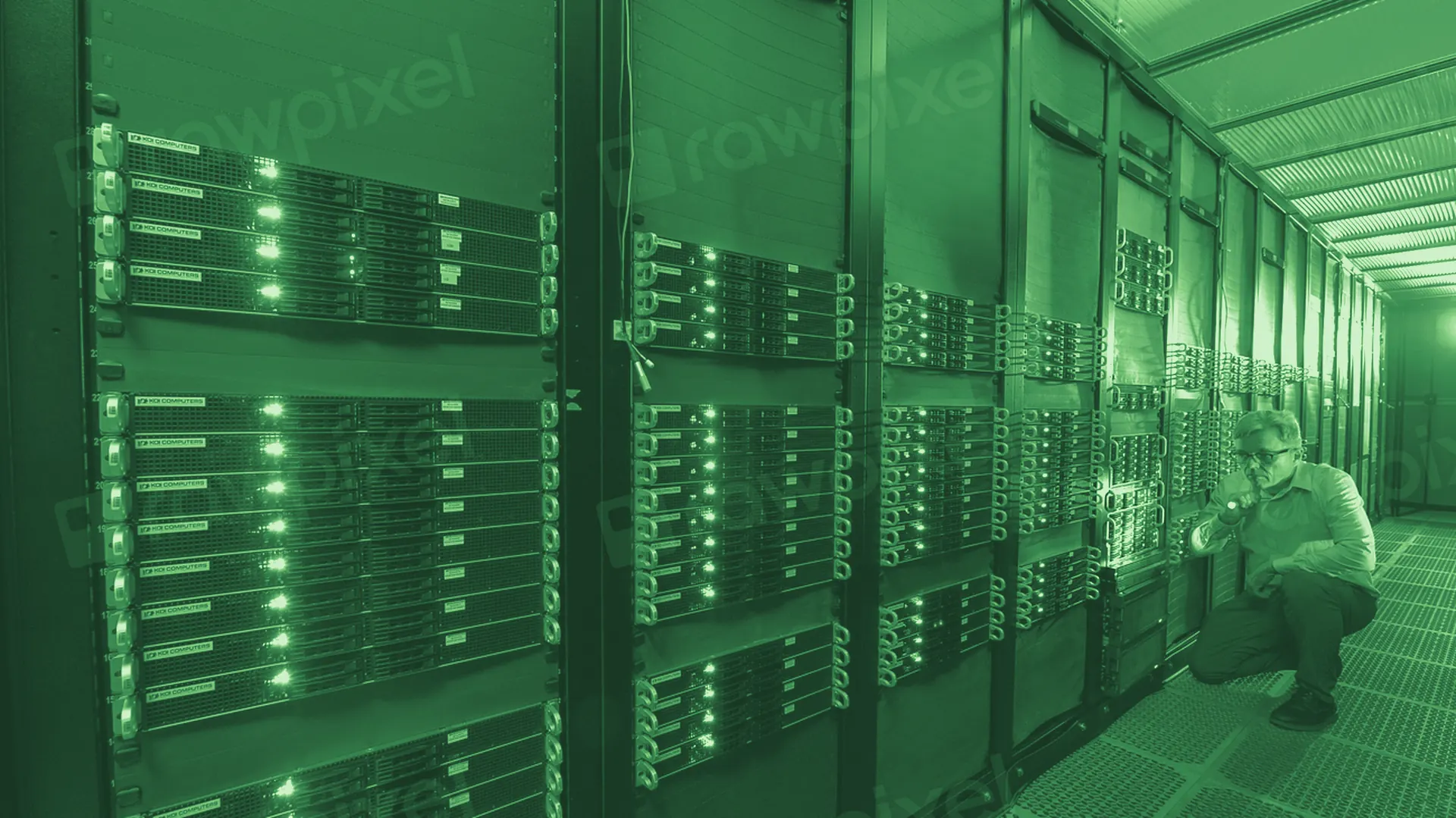
AI training is the process of fitting a model to data: the system reads examples, measures how wrong its predictions are, adjusts its internal parameters to correct them, and repeats the cycle until the result is acceptable for its intended use.
Training is the costly half of a model's life. It runs for a long time, holds large volumes of data and intermediate state in memory, and rewards hardware that moves numbers quickly between devices - which is why accelerators and fast interconnects dominate this workload category. What the finished model does in production, answering requests one at a time, is a separate activity with separate economics.
What a training run needs
The requirements of a run are mostly physical, and they compound:
- Accelerators - multiple devices working as one, each with enough memory to hold its share of the model and working data.
- Interconnect - fast links between devices so partial results can be exchanged without stalling the job.
- Feeding and checkpointing - storage fast enough to stream datasets, and periodic saved state so a failure costs a restart rather than the run.
- A scheduler - queueing, allocating and restarting jobs across shared capacity.
- A staged plan - a small configuration validated first, then scale and variations added in later stages.
Staging exists because each step answers a cheaper question than the one after it: whether the data and code are correct can be settled on a small configuration, while scale only becomes worth paying for once the earlier answers hold. Jumps straight to the largest configuration tend to discover trivial mistakes at the highest price.
Training is not inference
Inference is the other half of a model's life: running the trained weights against new input, per request, judged by latency and steadiness. Training runs offline in long blocks and is judged by the artefact it leaves behind. The two buy capacity differently - training wants a large block of devices for the duration of a run, while serving wants modest, continuously available capacity.
That distinction is why listings separate them. Standing allocations with defined shapes are sold as GPU as a service, and the marketplace carries both forms; see GPU compute listings for the capacity side.
Between training and serving sits evaluation: running the trained weights against held-out data and checking whether the result is fit to ship. It costs a fraction of the run that produced it and catches the failures that training alone cannot, because a model can fit its data closely and still behave badly on inputs nobody showed it.
Who buys training capacity
Typical buyers are research groups running experiments, teams adapting an existing model to their own domain, and organisations that need a run occasionally but cannot justify owning a cluster for it. Each arrives with constraints that are less about the accelerator model than about everything around it: where the training data may legally sit, how datasets and checkpoints will be staged, and how results will be reproduced.
Scheduling is part of the decision too. Capacity that is cheap but queues for a long time suits experiments with flexible deadlines; capacity that starts immediately suits a run on a critical path. Both are rational purchases, and they are bought from different listings.
Reproducibility is part of the purchase as well. A result that cannot be repeated from the same data and configuration is awkward to defend afterwards, so projects record the dataset, the software versions and the settings behind each attempt. That discipline grows harder, not easier, when a study cycles through several providers in sequence: an environment definition that travels with the job is what makes a claim checkable on unfamiliar hardware rather than merely plausible.
Training demand taken to the market
On an open market, training reaches providers as a stated requirement: how many accelerators, for how long, with what interconnect, and where the data may sit. The tenant funds an escrow account when placing that demand, so a provider can see real budget behind the request before it reserves devices for it.
The matched lease binds tenant, provider and escrow, and fulfilment runs through the provider's control plane into its scheduler. Utilisation is reported as signed records, disputed if either side disagrees, and settled from escrow after the window closes with any unused balance returned. Any VEID requirement is specific to the selected offer, not a universal condition. The procurement side of this - what to plan for when buying such runs - is covered in AI and ML workloads.
In practice
A training requirement is posted with device count, duration and data constraints; providers holding accelerators answer it, and the tenant's escrow pays out only for utilisation that is signed and uncontested.
Questions
Asked about what is ai training
What is AI training in simple terms?
It is the process that produces a model: the system works through data, measures its errors, adjusts its parameters, and repeats until the results are good enough. The output is the set of trained weights, not an answer to any single request.
What is the difference between AI training and inference?
Training creates the model and runs offline in long blocks; inference uses the trained model and runs per request, online. Training wants a large block of accelerators for a limited period, while inference wants steady, smaller capacity.
What hardware does AI training require?
Accelerators with sufficient memory, fast interconnect between them, storage that can stream datasets and hold checkpoints, and a scheduler to manage the jobs. The interconnect and checkpointing matter as much as the device count for runs of any size.
How is training capacity bought on a marketplace?
A tenant states the requirement - device count, duration, interconnect, data location - and funds an escrow account with the order. Providers answer it, the match becomes a lease, and signed utilisation records settle against escrow after a dispute window.
Related
Keep reading
- What is AI inference? AI inference explained: what the term means, which hardware and constraints matter, and how inference capacity is listed, metered and settled.
- What is GPU as a Service? GPU as a Service rents accelerator capacity instead of buying servers. What the model covers, what a listing must state, and how usage settles.
- What is HPC (high-performance computing)? What is HPC? High-performance computing joins many processors to finish large jobs faster: what clusters need, and how compute is bought per job.
- What is SLURM? SLURM is the cluster scheduler behind most HPC sites. What it controls, why it became the standard, and how its jobs reach the market.
- What is bare metal? Bare metal is a whole physical server for one tenant. When to choose it over virtual machines, what you take on, and how it is listed.
- All definitions Every cloud and marketplace term, defined in one place.
Longer explainers live in Learn; the full vocabulary is in the marketplace glossary.